Deconstructing the Gender Trinary

The “gender trinary” was established to be a counterpart to the binary, which is a system of two genders that are equally legitimized and enforced in societies. This trinary was always either male, female, and agender or male, female, and nonbinary - the third point seems to be replaced by different genders depending on who you ask. Some will even switch out male and female with masculine and feminine, as if they are interchangeable. Below is an example of some discrepancies you might find when looking into the gender trinary (from the LGBTQIA+ Wiki):
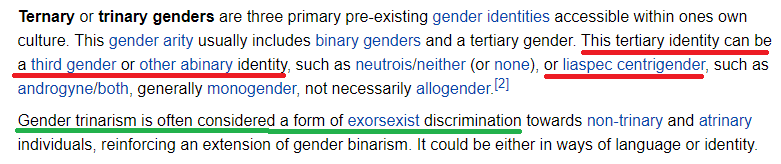
The trinary seems to be attempting to establish itself as rigid and specific, but then it fails to specify exactly what the “third gender” is within its model. Sometimes it’s “neither”, the unlabel meant to describe one’s non-applicability to binarity, while other times it’s neutrois or agender - lumping in neutrality with genderlessness will come up again in this essay. Rarely, the third gender of the trinary may be androgyne or some other androgynous centrigender. But even within this screenshot, you can see that gender trinarism is recognized as exorsexist. If you follow the link to that page, you’ll also notice that the term “trinary gender” is under the category “Conformant Terms” which implies that the tertiary gender - nonbinary, neutrois, or androgyne - falls within conformity.
This screenshot seen below is from the MOGAI Wiki page on péra, explaining the gender trinary as male/female/none but then adds that in some cases, it’s neutral. It even repeats this sentiment twice in the same paragraph. The original coining post for péra does in fact include the trinary in its definition, while many other terms - maverique being a common one - was never intended to acknowledge a trinary.
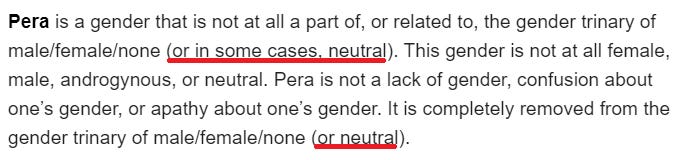
It’s clear to see there are flaws to begin with, but the biggest problem is that there are so many abinary genders that exist apart from any social construct like the binary that suddenly got pulled back into this new conformity when people started talking about a trinary. It also seems to imply, in all of its definitions, that this third point exists in proximity to the binary (or conventionality in general) and that only genders that fall outside of these three are entirely removed from convention. It implies agender or epicene (or whatever the third point happens to be) is on the same level of legitimization (not legitimacy) as male and female. However, someone who is nonbinary, or agender, or epicene (the ‘third’ gender in the trinary) does not have their gender legally and socially recognized in the same way male and female are.
Tumblr user themaveriqueagenda makes an excellent point, stating:
“[T]he third gender in the gender trinary is arbitrary - depending on which exorsexist you ask, they'll tell you ‘all nonbinary people are genderless,’ ‘all nonbinary people are a neutral gender,’ ‘all nonbinary people are a single third gender,’ or ‘all nonbinary people are in between.’
‘[G]ender trinary’ implies that there are exactly three genders that are socially and legally recognised; no nonbinary gender is recognised the same way that manhood and womanhood are in a western context (which most of these conversations focus on.)
[S]ome form of nonbinarity is thus somehow more privileged over others.
[I]n short, the gender trinary doesn't actually exist in western culture because it can't even be defined and most western cultures don't fully recognise any nonbinary genders.”
In society, two genders are legally and socially recognized: Male and female. Anything that fails to conform to these two (which make up the gender binary) are seen as invalid and in some cases, a mental illness. Despite the trinary including epicene - a nonbinary gender - bigots do not attempt to make the distinction between neutrality and outherinity, especially when enacting laws meant to restrict the definition of gender and sex. To these people, anything that is nonbinary is a threat to their precious binary no matter what kind of nonbinary it may be.
Nonbinarity was established as a concept to talk about breaking away from stringent socially constructed ideals of gender conformity and convention. In the queer community, countless identities have been recognized as not falling within the “rules” of what society at large considered to be a gender. These genders, inherently, subverted expectations. Suddenly, this gender trinary concept was established, and many of those nonconforming genders were pulled back in to fit into this model. Niaspec, aporine, and maverine identities were all shoved into a tertiary category that nobody asked to be included in. These abinary experiences are all delegitimized by the idea of a binary and so are removed from the binary by people who use the terms, seeing themselves as not a third point on a graph but existing in its own distinct realm. The trinary was created and it pulled those back into a forced construct again. This caused a divide between the “normal” nonbinaries and the ones who are simply “other.”
People will argue that the gender trinary is a way to categorize and discuss genders that are within the ordinous group of genders - male, female, and neutrois. But this idea is supposed to function in the same way the gender binary does. Otherwise, it doesn't make sense to recognize it as a construct or to use the -ary suffix. We do not need to use exorsexist concepts to describe our gender experiences, as there is plenty of accurate terminology to describe non-neutral abinarity. People have attempted to create new -arities as a “replacement” for the trinary by expanding how many identities are included, as seen here for the LGBTQIA+ Wiki page on gender quaternary:
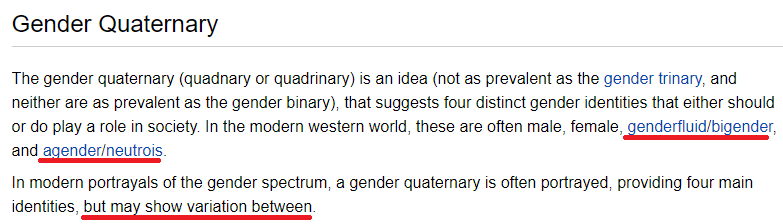
As you can see, the same problem arises: That anything that isn’t one of the binary points on this model can be several things depending exclusively on bias. This paragraph, oddly, states that one of the quaternary genders is “genderfluid/bigender” which must be assumed to be androgyne or some other binarine centrinity. Then, the fourth gender is “agender/neutrois”, which is meant to lump neutrality in with genderlessness; this ignores the fact that agender doesn’t typically fall into most gender categories because it is a lack of gender identity, therefore it isn’t neutral, abinary, atrinary, outherine, or under any other similar categorization.
Tumblr user theoutherlings had this to say:
“If you find non-binary too centered on a fem-masc-andro-neu continuum and you want to express that your gender it’s outside it, say anonbinary. Not atrinary/nontrinary or aquaternary/noquaternary, because neither neutrality nor androgyny, nor anything alike have the level of recognition and legitimacy by the western binary system femininity (specifically lierinity/erainity, and more specifically femaleness) and masculinity (specifically virinity, and more specifically maleness) have.”
This user has played a key role in the discussion of abinary gender experiences. As seen on their blog, outherine is the term to use for genders that are not masculine, feminine, neutral, or genderless. Another term would be anonbinary (also called anodiean), which simply encompasses the experience of being neither binary nor nonbinary. There are a number of gender labels and terminology that exist to talk about our experiences without throwing nonbinary people under the bus, especially those who do not fall within any sort of convention (for example: Those who are maverique, ilyagender, or péra.) It’s important to note that just because a term was coined and gained popularity in the community doesn’t mean that we need to use it, especially if it is causing material harm.
Further Reading
Follow the initial conversation on Tumblr (on the your-bigender-big-brother blog) about the gender trinary and the harm it causes as a concept in the queer community:
Anon asking why atrinary is an exorsexist term (link)
Another anon asking for clarification (link)
Latine anon explaining atrinary as anti-trinary (link)
Latine anon again (link)
Another anon, on treating nonbinary as a monogender (link)
Other links: